The inspection scope, read as a list of answerable questions
Six things are on the published list, three are named as outside it, and two more cannot be seen at all on a sealed product. Everything else defaults to agreement with the seller.
The operator publishes what the warehouse checks instead of leaving it to be inferred. That makes the scope readable before you order, which is the only time it is useful.
The published list, word for word
Upon the goods arrive at Lovegobuy warehouse, the appearance of the goods will be inspected by professional quality inspectors, such as color, large area of damage, stains, size, model, version number, etc.
Inspection scopes, help article 10086, read 2026-10-10
Six named items. Three of them, colour, damage and stains, need nothing from you: an inspector can see a stain without being told what to expect. The other three, size, model and version number, are comparisons, and a comparison needs a second value.
That second value comes from your remark and from the label. The published wording is explicit that apparel is subject to your product remarks, and that the size read is the one on the label and tag.
The same list as a ledger
Each line below is a thing people care about. The three cells say whether the inspection covers it, whether you have to supply a reference for it, and what happens by default when it cannot be settled.
What an arrival inspection can and cannot settle
- Checked against
- The size printed on the label and tag
- Your remark
- Write the label size you expect
- If it cannot be settled
- Settled against the tag
- Checked against
- The number stated in the listing
- Your remark
- Write the model or version number
- If it cannot be settled
- Settled against the stated number
- Checked against
- The goods as they arrived, with no reference needed
- Your remark
- Nothing needed from you
- If it cannot be settled
- Settled from the photographs
- Checked against
- The colourway named in the listing
- Your remark
- Write the colourway name
- If it cannot be settled
- Settled against the listing name
- Checked against
- Nothing; lighting, angle and screen differ
- Your remark
- A remark changes nothing here
- If it cannot be settled
- Ask support if the reference is insufficient
- Checked against
- Nothing; the garment is not measured
- Your remark
- A remark changes nothing here
- If it cannot be settled
- Ask support if the reference is insufficient
- Checked against
- Nothing a warehouse photograph can carry
- Your remark
- A remark changes nothing here
- If it cannot be settled
- Ask support if the reference is insufficient
- Checked against
- Nothing; the box stays shut
- Your remark
- A remark changes nothing here
- If it cannot be settled
- Ask support if the reference is insufficient
- Checked against
- Nothing; digital goods are not switched on
- Your remark
- A remark changes nothing here
- If it cannot be settled
- Ask support if the reference is insufficient
The right-hand cell is the one worth sitting with. It is not an open question that gets resolved when the parcel lands. It is a closed one, resolved in the seller's favour, at the moment the photographs are taken.
The three named exclusions
Colour difference, actual-size error and use effect are listed by name as outside the scope. None of the three is an oversight: each is a judgement that a warehouse photograph cannot carry, and the operator says so in the same breath as the reason.
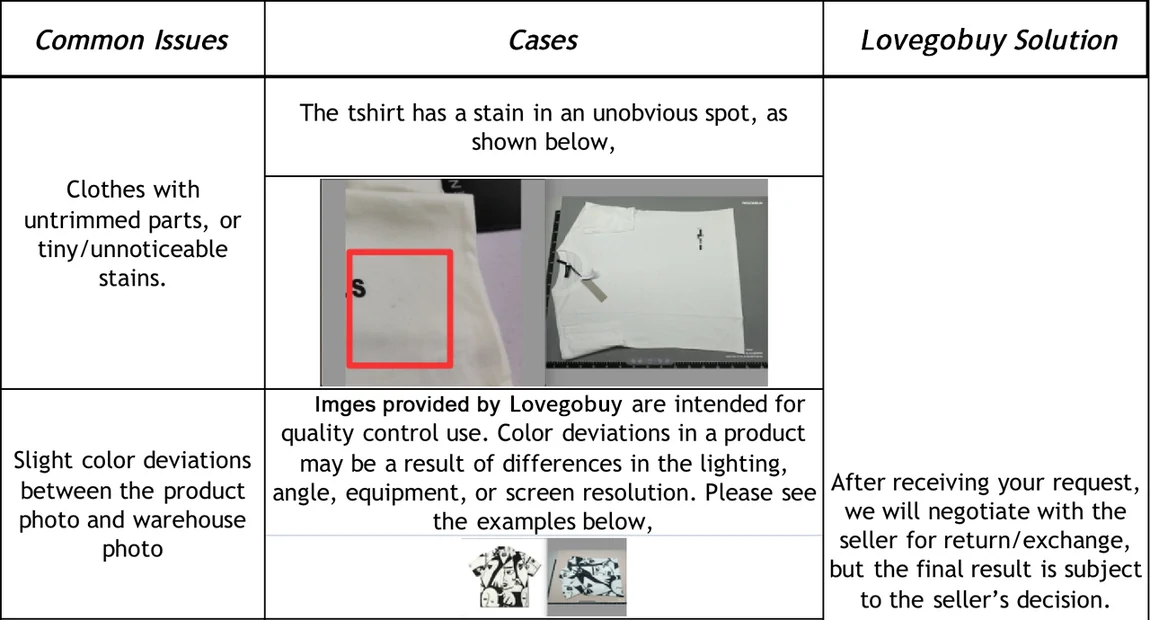
The explanation given for colour is specific: differences in lighting, angle, equipment or screen resolution. A warehouse photograph is lit for inspection, not for colour matching, and the same article says as much in a line worth keeping.
Imges provided by Lovegobuy are intended for quality control use.
Defective products, help article 10014, read 2026-10-10 (spelling as published)
Read that as a statement of purpose rather than a disclaimer. The photographs are instruments for one job. Asking them to answer a different question is where most disappointment comes from.
Digital goods, where the scope narrows again
Checked
The outside of the product, as it arrived. The inspectors photograph what can be seen without opening anything, and the published wording asks you to confirm the product from that arrival picture.
Not checked
Whether a sealed box holds every accessory, and whether the thing powers on. Both are named in the article as outside what the inspectors do, for every electronic and digital item rather than case by case.
This matters most for the categories where the box is the product claim. An earbud case photographed shut is a photo of a box.
Reading the QC photographs in a useful order
The photo strip arrives as a set, and most people open it like a gallery. Reading it against the scope is faster and answers a different question.
Find the label and the tag first
That is the reference the size and model checks were made against. If it is not legible in any frame, that is itself worth an extra photo request while the window is open.
Check the three that need no reference
Large damage, stains and a plainly wrong colour are inspected without you asking, so these are the ones where a finding is strongest.
Compare the rest against what you wrote
Size, model and version number are comparisons. Open your own remark beside the photographs rather than relying on what you meant at the time.
Stop before judging what the scope excludes
Shade, drape and finish are not what these frames were lit for, and the published default has already settled them.
A QC checklist that asks you to study the photographs harder is working against the published scope. The reading order above works with it.
The ceiling on any remedy
When an issue is raised, the published response is the same across every line of the issues table: the operator will negotiate with the seller, and the final result is the seller's decision. That is a real service and it is also a ceiling.
An agent can carry your argument. It cannot overrule the shop. Choosing a seller who answers questions is therefore part of the inspection strategy, not a separate topic.
Points this raises
Colour difference is excluded, but colour is on the list
Both are true and they are not the same test. A product photographed in blue that arrives black fails the colour check. A black that reads warmer than the listing photo is colour difference, which the article names as outside the scope.
The inspection reads the label, not the garment
The published wording says the inspection is based on the size on the product's label and tag. A garment labelled L is an L for the purposes of the check, whatever a tape measure would say.
Nothing was written in the remark
Then the comparisons have one value instead of two. Appearance faults are still inspected, because those need no reference, but size, model and version number have nothing to be checked against.
An issue was found after the parcel arrived
An issue noticed after delivery needs the actual order dates and applicable terms checked. This page cannot determine whether a deadline has passed. Contact official support promptly with the order, payment record, description and evidence; seller after-sales options and specific complaint routes may differ.