Browsing the Lovegobuy Spreadsheet with the inspection in mind
The catalogue is where a find starts. Choosing well here is cheaper than arguing later, because most of what goes wrong is decided by the listing rather than by the warehouse.
Sixteen categories, each opening on the catalogue. The line under each tile is the part of that category an arrival photo set will not settle for you.
 Category
Sneakersbox label against the pair inside  Category
Jacketslining and zip pulls, not drape  Category
Hoodiesprint placement, not hand feel  Category
Teeslabel size, not how it sits  Category
Jeanstag measurements, not stretch  Category
Joggerswaist tag, not rise on you  Search
Womenswearstated size, not fit  Category
Football shirtsbadge and name set, not fabric weight  Category
Bagshardware and stitching, not smell  Category
Capsbrim shape, not crown depth on you  Category
Beltsholes and buckle, not length worn  Category
Eyewearframe and case, not lens tint accuracy  Category
Fragranceseal and box, never the scent  Category
Jewelleryclasp and finish, not plating life  Category
Watchesdial and strap, never timekeeping  Category
Electronicsoutside of a sealed box only
What this guide adds to the catalogue
The catalogue tells you what exists and what other people bought. It does not tell you which of the things you care about are checkable once the goods are in a warehouse. That gap is what this site fills, and it fills it from the operator's published scope rather than from opinion.
Every number and every rule quoted here carries the help article it came from and the date it was read. Where the operator's own pages disagree with each other, both figures are printed with their sources rather than one being chosen quietly.
Judging a listing before it becomes an order
A listing that states measurements in centimetres gives the inspection something to read. A listing that offers only a size letter does not, because the check reads the label and the tag, and the label will say whatever the maker printed.
| What the listing shows | What survives to the warehouse | What to do about it |
|---|---|---|
| Measurements in centimetres per size | A number you can put in the remark | Write the measurement and the size in the remark |
| A size letter only | A label the inspector can read, nothing to compare it to | Ask the seller for the flat measurements first |
| Several colourways in one listing | A colour name the inspection can check | Name the colourway in the remark, not just the swatch position |
| A model or version number in the title | A number that is on the inspected list | Repeat it in the remark so there is a value to match |
| Photographs only, no stated specification | Appearance faults, and nothing else | Treat fit and finish as unverifiable before you order |
The same size list, before and after translation
Size options are written by the seller in Chinese and rendered into English by the interface. The pair below is one listing, shown both ways, and it explains why a size letter is a weaker reference than it looks.
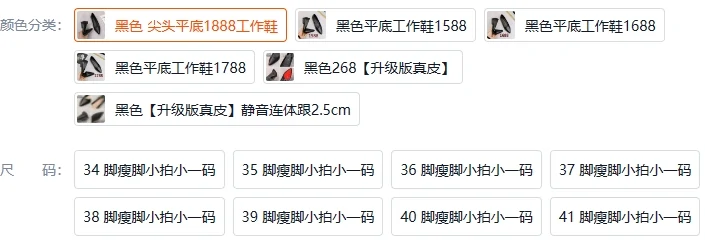
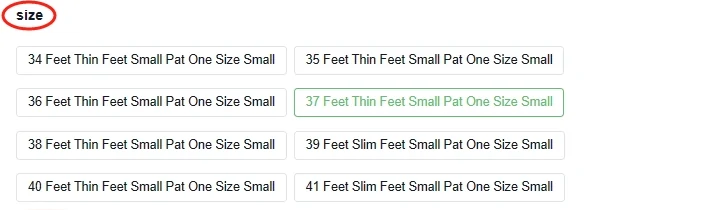
Nothing is lost that matters to the inspection, because the check reads the label rather than the option name. What is lost is your confidence that you picked the right one, which is exactly what a remark restores.
Choosing a seller you can get an answer from
The inspection stage has a ceiling that is easy to miss. When an issue is raised, the operator's published answer is that it will negotiate with the seller, and that the final result is the seller's decision. A seller who replies before you buy is the same seller who will reply afterwards.
- Ask one specific question before ordering and see whether the answer is specific back
- Prefer shops that state flat measurements rather than a size chart image
- Treat a listing with no stated specification as a listing where only appearance is checkable
- Note the shop name, because the warehouse entry shows the product identifier but your argument will be with the shop
How to judge a Spreadsheet site before you rely on it
A catalogue is only as good as its maintenance. The questions worth asking are plain: when was it last touched, do the outbound links still resolve, does it say where its facts came from, and does it print a date next to anything that can go stale.
Applied here: every outbound link on this site was requested and returned 200 before publication, every operator fact carries an article number and a read date, and the freshness record is published as a file rather than described in prose.
Why this guide is kept the way it is comes down to one habit: anything that can go stale is dated, and the dates are published rather than described. A guide updated every few months with no record of what was read is indistinguishable from one that was written once.