Tags and packaging, and what removing them costs
Asking the warehouse to cut the tags or leave the box behind is the most ordinary weight-saving request there is. The dated policy lists removal-related return exclusions, and removing a tag can also remove a useful comparison reference.
Nothing here argues that you should never ask. It argues that the trade is worth seeing before you make it, before authorising a change to the item.
The published ineligibility list
The return and exchange rules name the categories that cannot use the service. Most of them are properties of the goods. One of them is a property of your instructions.
| Not eligible | Why it is on the list | Decided by |
|---|---|---|
| Custom-made or tailored goods | Made to your specification, so there is nothing to restock | The nature of the item |
| Goods marked non-returnable in the listing | The seller declared it before you ordered | The listing |
| Packaging, tags or accessories removed at the user's request | The goods no longer match what the seller shipped | Your own instruction |
| Newspapers and periodicals | Dated goods | The nature of the item |
| Second-hand goods | No restock path | The nature of the item |
| Goods from outside the Chinese mainland | Outside the domestic return network | The seller's location |
Five of the six are settled before you act. The third is the only line on the list that you write yourself, usually in a free-text box, usually in one short sentence.
Why tags specifically cost twice
The dated inspection scope refers to the product label and tag. Removing a tag may remove one reference, but another sewn-in label or product marking can remain. Check the actual item and confirm return eligibility before requesting any removal.
One request, measured against both articles
- Checked against
- The size printed on the tag
- Your remark
- Write the size you expect
- If it cannot be settled
- Settled against the tag
- Checked against
- Check whether another label remains
- Your remark
- Check remaining references
- If it cannot be settled
- Ask support if the reference is insufficient
- Checked against
- The number stated in the listing
- Your remark
- Write the version you expect
- If it cannot be settled
- Settled against the stated number
- Checked against
- The number on the product itself
- Your remark
- Write the version you expect
- If it cannot be settled
- Confirm the visible marking and removal-related return exclusion
A model marking may remain on the product after a box is removed. That is a separate question from return eligibility: the dated policy lists user-requested removal as an exclusion. Ask support about the actual case.
Where the weight argument actually sits
Resolve the return question before choosing minimal packing.
Start with the item you have received, its current countdown and the reason for any concern. If the wrong variant arrived, save the authorised option and the image showing the difference. If the item matches but you are unsure about fit, ask for the missing measurement before assuming the same return grounds apply.
Keep tags, seals and retail packaging that the applicable return rules require while the decision is open. “Remove the box” and “remove every label” are different instructions. Confirm the exact action rather than treating them as one general weight-saving preference.
Once you decide to ship, compare the packing choice against the type of goods and the route. A fragile object may need the protection its retail box provides; a soft garment raises another question. Less packaging does not automatically produce a lower billed weight, because the final dimensions, rounding and channel rules still matter.
The shipping screen below records item dimensions and route choices. Use that point to compare the parcel you are actually submitting. Keep the final contents, packaging instruction and route record so a later question can be traced to what you authorised.
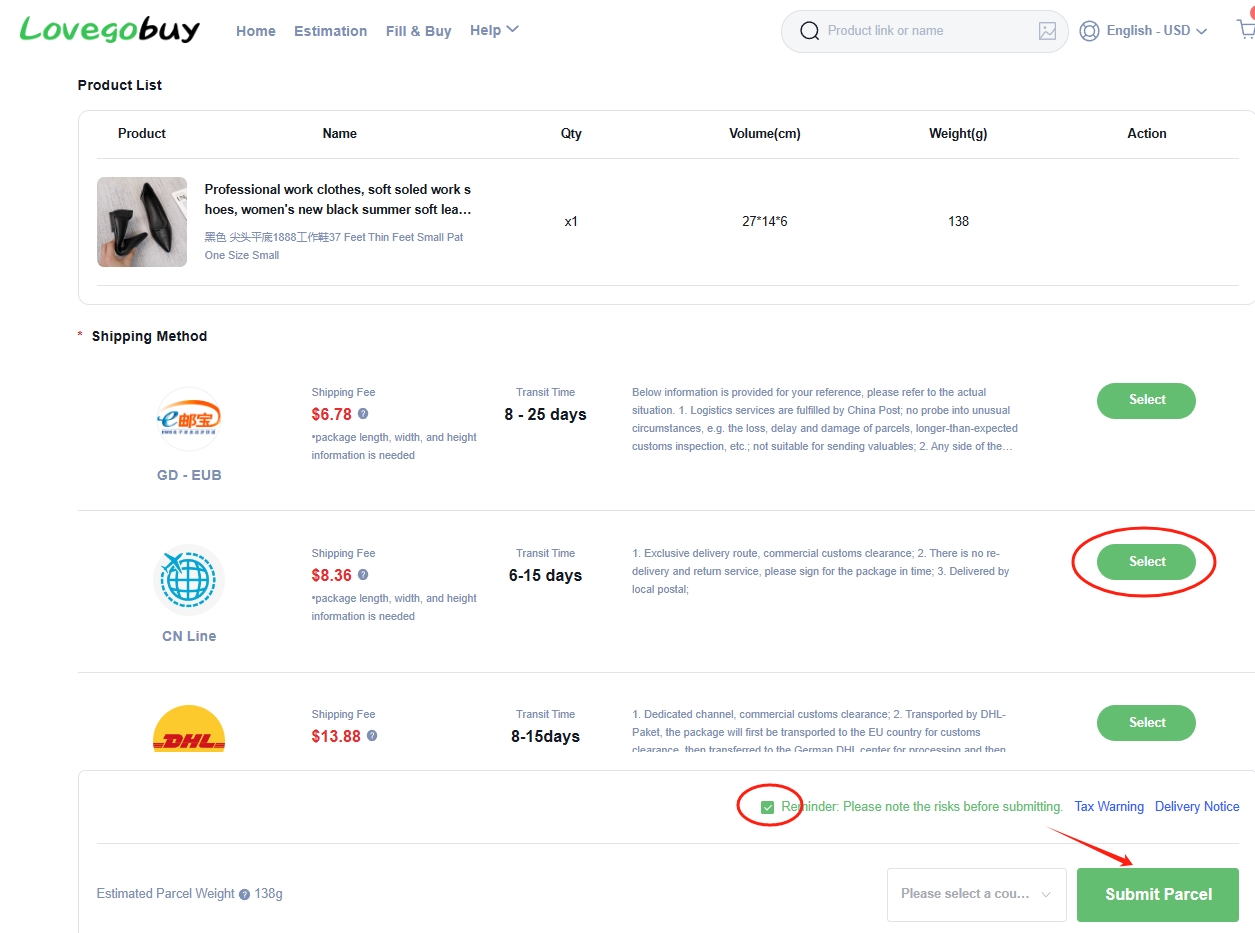
Weight is charged at the submit stage, which happens after inspection and warehousing. By then the tags have already done their job for the check, which suggests an order of operations rather than a choice between two goods.
Order with the tags left on
The inspection has a label to read and the comparison can return an answer.
Read the free photos when the item reads stocked in
Review the photos promptly while the item is in the warehouse and check the current return countdown.
Decide, then strip
Only request removal after reviewing the item and accepting the effect on return eligibility and protection during shipping.
The published rules do not describe this sequence anywhere. It falls out of putting the inspection scope and the ineligibility list next to each other, which is the whole method of this site.
Consolidation, and the items that refuse it
Items sitting in the warehouse can be combined into one parcel or sent in several shipments. Two groups refuse to be combined: anything with a side of 90 cm or more is tagged for individual packaging and ships alone, and goods under mailing restrictions cannot travel with others.
A long item changes the arithmetic before any tag is cut. If one piece in your warehouse list has a 90 cm side, it is a parcel of its own, and the grams you were saving on the others were never going to join it.
Points this raises
The request was made and the item turned out wrong
The published list treats goods whose packaging, tags or accessories were removed at the user's request as ineligible for return or exchange. The operator can still raise it with the seller, and the issues table says the final result is the seller's decision.
Tags removed by the seller rather than by you
The list names removal at the user's request. A listing sold without tags is a property of the goods, which is a different line of the same table, and worth settling with the shop before ordering.
Keeping the tag but discarding the box
That keeps the size reference and gives up the remedy. It is a defensible trade once you can see both halves of it, which is the point of putting them in one table.